Stiffness: the forgotten parameter in precision drive systems
When designing precision drive systems, the focus is often on backlash, accuracy, and repeatability. An equally important, but often underestimated, parameter is stiffness. The stiffness of a drivetrain largely determines the dynamic behavior, controllability, and ultimate positioning accuracy of a machine.
What is stiffness?
Stiffness describes the resistance of a mechanical system to deformation under load. In rotary drives, torsional stiffness is usually discussed, expressed in Nm/rad. The higher the stiffness, the smaller the twist at a given torque.
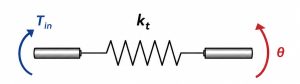
In a drivetrain, the total stiffness consists of multiple components, such as:
- gearbox,
- coupling,
- motor shaft and output shaft,
- rack and pinion or other transmissions.
The lowest stiffness in the chain ultimately determines the system behavior.
In a servo drive with a compact planetary low-backlashe gearbox of Apex Dynamics, the torsional stiffness of the gearbox can be a determining factor for dynamic performance. In pick-and-place applications with high gears, a rigid planetary gear ensures that motor movement is transmitted almost directly to the load, without noticeable elastic twisting.
Stiffness versus backlash
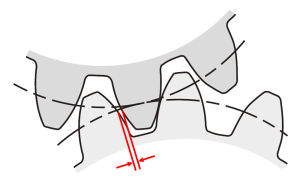
Backlash and stiffness are often confused, but they describe different effects. Backlash causes a “dead zone” during changes of direction, while low stiffness leads to elastic deformation under load. Consequently, even completely backlash-free systems can exhibit positional errors, particularly under fluctuating or dynamic loads.
Backlash-free and super-stiff structures can also exhibit positional deviation; this is called “Hysteresis” or “lost-motion.”
A typical example is a linear axis that deforms by a few micrometers under load. The servo control compensates for this by providing extra torque, but the deformation remains present as long as the load persists. With linear axes featuring an Apex rack and pinion system, the backlash can be virtually zero, while the total system stiffness is still limited by the rack, the pinion, and the gearbox bearings. Under fluctuating process forces (for example, during contour milling or dosing), a small elastic displacement then occurs, despite a backlash-free transmission.
Influence on dynamics and behavior
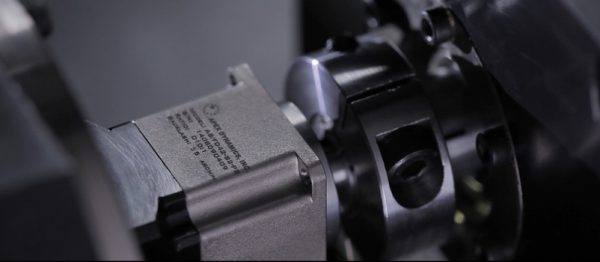 The stiffness of the drivetrain has a direct influence on:
- the natural frequencies of the system,
- the maximum achievable control bandwidth,
- the sensitivity to resonances and vibrations.
Low stiffness results in a “soft” system that is more difficult to control stably and quickly. This often leads to conservative control settings, longer setup times, and limitations in acceleration and cycle time.
In packaging machines where vertical movements are realized using, for example, Apex AP-series gearboxes, high torsional stiffness is essential. During rapid accelerations and decelerations, the rigid transmission prevents the load from vibrating after the initial movement, enabling higher cycle speeds without compromising positioning accuracy.
Couplings as a critical link
In many drive systems, the clutch appears to be the weakest link in terms of stiffness. Although a coupling can be free of backlash, this does not automatically mean that it is sufficiently torsionally stiff for dynamic applications. The choice of coupling type therefore has a major influence on the overall system behavior.
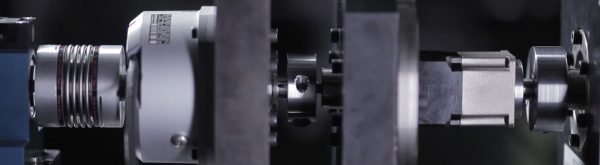
When a servomotor with a rigid Apex gearbox is combined with a relatively flexible elastomer clutch, the entire drivetrain can still feel “springy”. In such cases, an Apex multi-plate clutch (D-series) offers significantly higher torsional stiffness, while still compensating for misalignment. This results in a more direct response and better positioning performance.
Rack and pinion: often underestimated
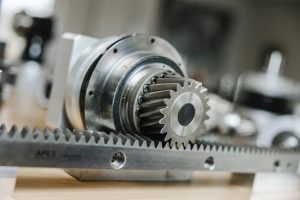
In rack and pinion linear systems, stiffness is determined not only by the tooth shape but also by the module, the pinion width, and the gearbox bearing.
For long gantry shafts with Apex racks and pinions, a stiffer configuration results in a significant improvement in contour tracking accuracy. Particularly under varying loads, such as when handling heavy products, high system stiffness prevents the load from “lagging” elastically.
Practical design considerations
 When designing a precision drive, it is advisable to:
- to include stiffness as a design parameter alongside backlash and accuracy,
- to assess not only components but the entire drivetrain,
- to take maximum load and dynamic forces into account,
- to tune stiffness to the desired control performance.
Conclusion
Stiffness largely determines how accurately, quickly, and stably a drive system functions. By incorporating this parameter early in the design process, performance limitations and control issues can be prevented at a later stage. In precision applications, stiffness is therefore not a detail, but an essential design choice. Apex Dynamics is happy to help you make the best choice from the extensive range of possibilities.
In precision applications, stiffness is therefore not a detail, but an essential design choice.