The bolt must never be the weakest link.
Apex Dynamics gearboxes are built to withstand heavy loads for years. However, when it comes to reliability, there is one component that is often overlooked: the bolts securing the gearbox to the machine. We regularly receive questions from customers about which bolts to use, which is why we have written this article. We explain exactly what a bolt’s strength class means, what happens when it is loaded to the limit, and why Apex Dynamics recommends using bolts with a strength class of 12.9.
What does the strength class say about a bolt?
The strength class of a bolt indicates how much force a bolt can withstand before it permanently deforms or fails. This classification is internationally standardized under ISO 898-1 and is indicated on the head of a bolt with two digits separated by a dot.
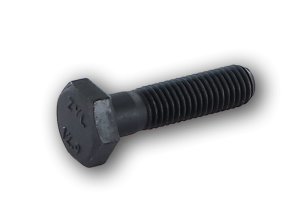
The first number, multiplied by 100, indicates the minimum tensile strength in N/mm², the maximum tensile force a bolt can withstand before it breaks. The yield strength, the point at which the bolt begins to deform permanently, is calculated by multiplying the first number by the second and then multiplying by 10. From the yield strength onwards, the bolt does not return to its original shape after the load is removed.
For example, a bolt with strength class 4.8 has a minimum tensile strength of 400 N/mm² and a yield strength of 320 N/mm². Bolts of this strength class are primarily used for lightly loaded, non-critical connections. Strength class 8.8 therefore has a tensile strength of 800 N/mm² and a yield strength of 640 N/mm² and is thus widely used in general construction, heavy machinery, and load-bearing structures. Class 10.0 reaches a tensile strength of up to 1,000 N/mm² and a yield strength of 900 for use in heavily loaded connections, vehicles, and engines. The strongest in the series, a bolt with strength class 12.0, has a tensile strength of 1,200 N/mm² and a yield strength of 1,080 N/mm² and is used in critical, very heavily loaded structures. The 12.9 bolt is therefore three times as strong as a 4.8 bolt.
What happens when you keep tightening a bolt: stress-strain diagram
To understand what happens when a bolt is subjected to increasing loads, we use a stress-strain diagram. This diagram shows how the material reacts as the force increases and passes through four distinct phases.
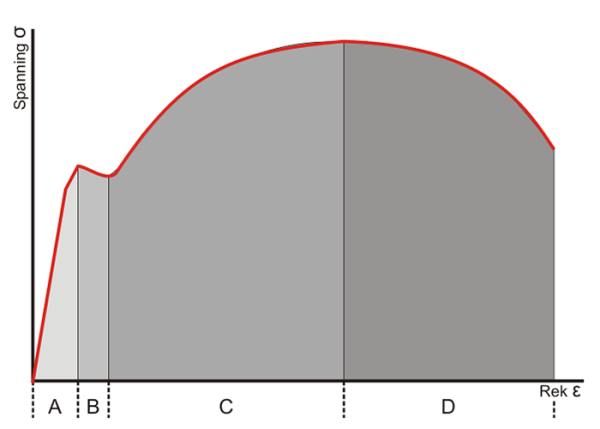
Elastic behavior – phase A
In the first phase of the load, the bolt shows elastic behavior. This means that the material temporarily deforms as long as a force is applied to it. As soon as the load is removed, the bolt returns to its original shape and length. The deformation is therefore not yet permanent in this phase. The highest point at the end of this phase, between A and B, is called the yield strength. Up to this point, the material behaves primarily elastically.
Plastic behavior – flow – phase B
When the load is increased slightly further and the yield limit is exceeded, the material begins to yield. From this moment on, plastic deformation occurs. This means that the bolt does not fully return to its original shape after the load is removed.
In this phase, a distinction is made between the upper and lower yield limits. The highest point is the upper yield limit and the lowest point is the lower yield limit.
Plastic behavior – reinforcement – phase C
After the yield point, the load is further increased. As a result, the bolt continues to deform plastically, but the material simultaneously begins to harden. This means that increasingly more force is required to cause further deformation. Consequently, the stress in the material increases again.
The highest point of this phase, between C and D, is the maximum tensile strength. For a bolt, this is an important factor, because the tensile strength indicates the maximum tensile force the bolt can withstand before the material begins to weaken further.
Plastic behavior – constriction and rupture – phase D
After reaching maximum tensile strength, the final phase of plastic behavior begins. At a specific point in the bolt, the material becomes locally thinner. This phenomenon is called necking. Because the cross-section at this location becomes progressively smaller, the material can eventually withstand less and less force.
When the load is maintained, the bolt will continue to stretch at the point of necking. Eventually, the necking becomes so severe that the material breaks. The point at which this occurs is called the breaking point or fracture stress.
From 4.8 to 12.9, where are these classes used?
Strength class 4.8 is used virtually nowhere in Europe, but is still regularly seen in products from countries such as China and India. Class 8.8 is still widely used, for example in construction to connect heavy steel profiles. In mechanical engineering, classes 10.9 and 12.9 are now primarily used.
Why Apex Dynamics chooses strength class 12.9 bolts
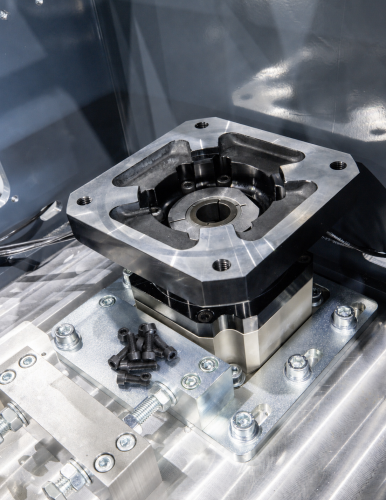
Apex Dynamics supplies the motor bolts as standard with its gearboxes. These bolts, but also the bolts used in the gearbox itself, are strength class 12.9. This is a conscious choice, if you make products that are among the strongest and most reliable products on the market, it is logical to also use the strongest components for mounting.
That is also where our advice comes from to use strength class 12.9 bolts for mounting the gearbox on the machine. This makes the entire connection suitable for heavy loads and optimally matches the performance of the gearbox.
The difference is almost invisible to the naked eye. In the accompanying photo, you can see an Apex Dynamics gearbox in which strength class 4.8 bolts have been used—this is indicated on the bolt head—and is clearly different from the 12.9 bolts that Apex Dynamics uses as standard and supplies with its gearboxes (see the small black bolts).
A connection is never stronger than the weakest link in the chain. Apex Dynamics consistently chooses strength class 12.9 for both the gearbox and the supplied mounting bolts. This contributes to the safety, reliability and lifespan of the machine.
Do you have any questions or would you like personal advice from one of our specialists? Please contact sales@apexdyna.nl or call +31 (0)492 509 995 and you will always receive an answer within 24 hours on working days.