Hygienic design as a foundation for food safety, also in drives
In the food and packaging industry, downtime is the greatest enemy. This applies not only during production but also to the time required for thorough cleaning. After all, every machine that processes food must be cleaned daily with aggressive chemicals. Yet, the drive system is often only selected in the final design phase, even though it is precisely there that the foundation is laid for a truly hygienic system. In this article, you will read how material choice, design, and lubricants determine whether a drive truly meets the strictest hygienic requirements.
Hygienic design does not start with the finish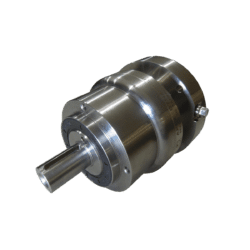
Many engineers think of hygienic design as a finishing matter: rounded corners here, a smooth layer of paint there. But the choice of the drive system—consisting of the servo motor and the gearbox—determines early on how cleanable a machine will ultimately be.
In segments such as cheese processing, meat, or dairy, contaminants like listeria are not a theoretical danger; they dictate the entire machine architecture. A machine that cannot be cleaned quickly and completely is simply not an option in the food sector. Residues, bacterial growth, and downtime due to contamination risk: the consequences are direct and measurable.
That starts with the material. In this context, stainless steel (SS) is not just a certification requirement; it is a functional argument. Stainless steel is corrosion-resistant, easy to clean, and resistant to the aggressive acidic and alkaline cleaning agents that are standard in the food industry. A surface that does not corrode does not harbor bacteria. Several series of Apex Dynamics gearboxes are already equipped as standard with a stainless steel housing and output shaft, hollow shaft, double output shaft, or flange. Product data is engraved into the steel and remains legible, even after hundreds of cleaning cycles.
No dead zones, no compromises
Hygienic design is about what is not there: no dead zones where moisture and dirt accumulate, no joints that cleaning agents cannot reach, and no materials that slowly degrade due to chemical stress.
In drive systems, this translates into concrete choices. The round housing of the AE series is no coincidence: a cylindrical shape has no corners, allows cleaning water to drain freely, and is accessible from all sides. Seals on the input and output sides are made of Viton with a double lip and an encapsulated vulcanized metal ring; reliable, traceable, and resistant to daily cleaning dynamics.
For applications where the entire drive must be executed in stainless steel, Apex Dynamics has developed the AES and AERS series. These are made entirely of stainless steel and are specifically intended for environments where stainless steel servo motors are increasingly being used. They offer the same specifications as the standard series: no concessions on torque, radial forces, or backlash accuracy.
Eric Megens – Sales Manager Apex Dynamics: “I regularly visit machine builders in the food sector who only select their drive in the final phase of the design. By then, the space is already determined, the motor flange has been chosen, and the gearbox has to adapt to whatever is left over. That works, but it is rarely optimal.
What I see often is that engineers then choose what is quickly available or what they are familiar with. Understandable. But especially in food applications, you pay for that choice later: in a cleaning procedure that takes longer than necessary, in a seal that shows wear sooner due to cleaning agents, or in a component that lacks the correct certification.
We try to enter the conversation early. Not to sell, but to think along. If you know what the machine has to endure in terms of cleaning, temperature fluctuations, and chemicals, then you select a drive that is truly built for that. And then you also notice that stainless steel doesn’t have to be more expensive if you calculate it correctly. After all, the lifespan, maintenance costs, and cleaning time all count.”
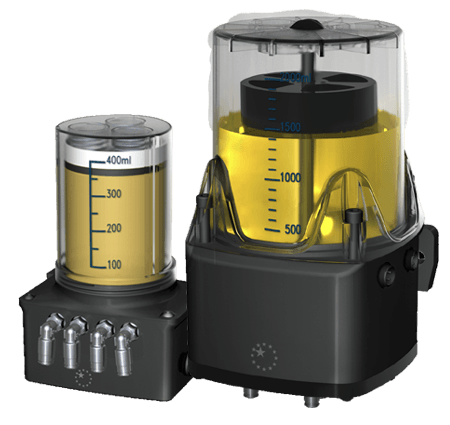
The lubricant: a detail with major consequences
The lubricant inside the gearbox also determines whether a drive is suitable for the food industry. The NSF classification (H1, H2, and H3) indicates the extent to which a lubricant may come into contact with food. H1 is the highest class: permitted for applications where limited contact with food is possible, based on an FDA-approved list of ingredients.
The practical difference lies not only in safety but also in the management burden. Those who exclusively use H1 lubricants do not need to include lubricants as a risk factor in the HACCP procedure. That saves time and administration structurally over the entire lifespan of the machine. The AES and AERS series from Apex Dynamics are filled with NSF-H1 certified lubricant as standard. No extra order, no adjustment, and no doubt.
In practice: Sleegers Technique special machine
A good example of hygienic design on a large scale is the production line for ready-to-eat bacon by Sleegers Technique. No fewer than 118 gearboxes are integrated into this machine. For such an application, there is no room for compromise: every individual drive must consistently meet the strictest requirements regarding cleanability and food safety.
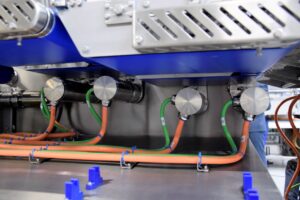
Sleegers chose full stainless steel gearboxes from the AES series, which come standard with food-grade lubrication. Because the machine is cleaned intensively, the corrosion resistance of the stainless steel and the reliability of the seals are crucial for uptime. A single concession on quality would, in this design, mean a risk of contamination or premature wear 118 times over. The result is an innovative installation where the drive technology fully supports and reinforces the philosophy of a virtually aseptic production environment.
Conclusion
Stainless steel, food-grade lubricants, round housings, and Viton seals: these are not luxury options for special cases. In the food processing and packaging industry, they are basic requirements. The only question is whether you include them in the design phase or later. and earlier is, of course, always better. A drive that is aligned with the machine’s cleaning requirements from the start simply works better, lasts longer, and costs less in the long run.
Do you have questions or would you like personal advice from one of our specialists? Then contact sales@apexdyna.nl or call +31 (0)492 509 995 and you will always receive an answer within 24 hours on working days.